7-13-07
What a weekend! It was quite a whirlwind. The traditional live music turned out to be more of a classical guitar concert (which suited me fine—I love that kind of music) along with an eclectic group organized by a large man from Switzerland, who played everything from Irish Highland dance music to baroque pieces using mandolins, ukuleles, guitars, a guitarón (large Mexican guitar, sounds kind of like a stand up bass), baroque string instruments, a lute, a flute, penny whistles, train whistles, bike horns, clown bells, spoons, small percussion instruments and brooms. They were very talented, and each of the 5 musicians played at least 4 different instruments during their part of the concert! All in all a very enjoyable evening.
On Saturday I got up early and got on an “expreso” bus to
Given my recent bus fiasco I decided to suck it up and pay the whopping $3 for a cab up to Catarina Mirador, a touristy look out at the top of a pueblo called Catarina where you can see out over the Laguna de Apoyo all the way to
From Catarina, I walked down the hill and crossed the highway into San Juan del Oriente, the town where much of the ceramic in
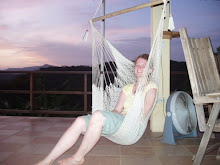
After buying a couple of small pieces, I wound my way back up to Catarina, where I found the mirador (lookout) crowded with tourists—I’m glad I went early! I had a quick lunch, and then walked back to the highway where I caught a bus (6 cordobas/$0.30) back to Masaya. After dropping my loot in my room, I walked out to the Malecón, a somewhat run-down walkway at the edge of town overlooking the Laguna de Masaya. As it usually is in the afternoons here (in fact, as it has every afternoon that I’ve been here…) it was raining and misty, but I had my umbrella, and the clouds made for a very eerie, haunted view of the smaller Laguna with its dramatic cliffs. After walking along the Malecón, I headed back the way I had come to the hammock factories. These seem to all be family owned and run out of houses on the west side of Masaya. There are several traditional designs, and each house that I went to had variations on the theme, but I found one hammock whose colors and size seemed perfect, and so I bought one! Size-wise, it is by far my largest purchase while traveling, and no doubt it will be a pain in the ass on my way back to
With hammock nicely wrapped up and in hand, I walked back to my hotel to set it down, and then went out again to round out the day with a bit more shopping, this time at the National Handicrafts Market. After seeing where the goods were made (and the “warehouse” prices…) I wasn’t that thrilled with the market. It was crowded with tourists, and the vendors were much pushier about making a sale than anyone else I had encountered that day. I did find some good T-shirts, and saw some lovely paintings that I wished I could transport. I also saw a neat wooden mask that I would have liked to buy, but couldn’t because I had run out of cash. Next time! By 5:30 I was exhausted, and all the shops blurred into one mass of bright colors, so I went off to have some dinner and then walked back to the hotel.
This morning I woke up to no power! As my room was downstairs in the hotel, it only had one window looking into the main courtyard/breakfast area, so I had almost no natural light. Packing up was a challenge, and I was so worried I was going to leave something behind! After eating breakfast, I asked one of the women for a flashlight, and did a once over of my room to make sure I didn’t forget any thing, and then, with my bags locked up with the front desk, I hopped in a taxi to go see the Volcán Masaya Parque National. This park was the highlight of my trip so far! According to my book, Volcán Masaya is one of the most visibly active volcanoes in the country, and it spouts something like 50 tons of sulfur into the air daily. The landscape around the volcano is strange and broken, and as you drive up to the crater you can see big craggy patches of petrified lava sticking out from the vegetation. The crater itself is one of the most awe inspiring things I have ever seen; it’s huge, with a great column of white smoke billowing up out of the volcano’s maw. The rocks are deep red, black and startlingly white in places, and where you might think to see sedimentary layers you find instead the broken surface of the wall, very clearly in tumult still from its 1852 eruption. Apparently, in 2000, it spat out a single boulder that crushed an Italian tourist’s car in the parking lot! Standing that close to an opening in the earth’s crust makes one think quite forcefully about how amazing it is that we live so peacefully right above such heat and toxic tumult. I took a tour into one of the caves made by a long ago eruption that at one time connected Volcán Masaya with its Laguna. Many sections of the tunnel have caved in, and for that reason we were able to walk into a part of the tunnel that is no longer connected to the gas spewing giant close by. The cave is now home to several species of bats (which we saw quite close up… they have such funny scrunched little faces!), and has been infiltrated by enormous tree roots. At the end of the tour we came to a large chamber where the Chorotenga Indians practiced their magic and prepared children and virgins for sacrifice to appease the god whose anger was shown in the activity of the volcano—after preparation, the one to be sacrificed was brought to the top of the crater and thrown in, alive. When the conquistadors came, their priests were convinced that it was a gate of hell, the abode of the devil, and stuck a big cross on the point where formerly the sacrificees were shoved off. Through the generations the volcano continues to inspire all manner of madness.
After looking one more time into the crater, I got back into my taxi and went back to Masaya for lunch before catching the bus to
Onward, tomorrow, to week three of classes!

No comments:
Post a Comment